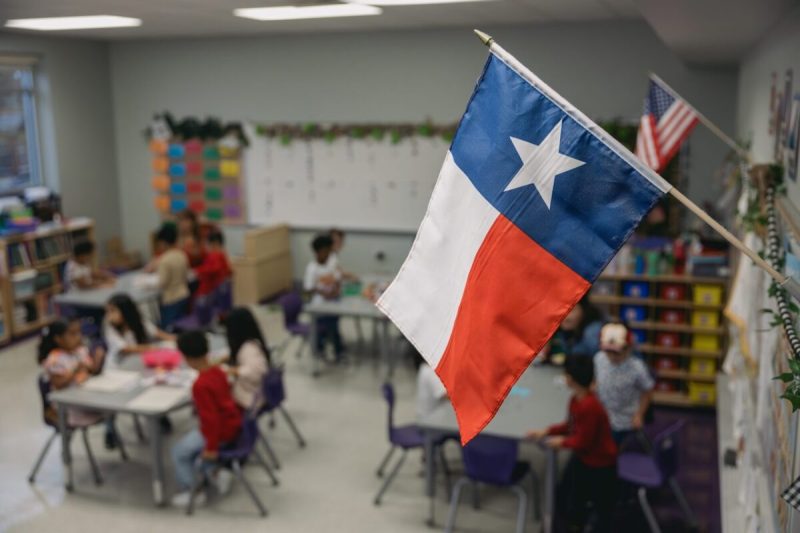
The politicization of Texas classrooms continues as the State Board of Education (SBOE) will deliberate rushed social studies teaching standards next week that put a greater emphasis on Western and Texas history at the expense of other cultures.
One of the most important things a teacher can do—according to Ellen Alexandrakis, an educator of over 20 years—is to ensure that students have a chance to see themselves in the literature they read and the history books they study.
But thanks to a hyper-partisan panel overseeing a social studies re-write for the state’s Texas Essential Knowledge and Skills (TEKS) standards, that may no longer be possible to provide for Texas’ 5.5 million public school students.
The State Board of Education (SBOE) typically reviews and updates TEKS for different subjects every 10 years to maintain relevancy. This year, however, the rushed changes are facing backlash for leaning too heavily into “Texas-centric” and white Christian teachings while ignoring the majority of world history, along with other religions and cultures.
“ For a child to go to school and be made to feel that they are anything less than an essential member of their community, that’s unethical,” Alexandrakis told COURIER Texas. “It’s wrong, and it’s teaching other children to be suspicious of other religions and other cultures.”
In outlined plans, third through seventh grade curriculum will connect world, US, and Texas histories, but world cultures and geography will only be taught “where appropriate.” In eighth grade, the courses will prioritize Texas and teach the history of “Texas and America as leaders in the nation and world” as opposed to the broader focus on national history that currently exists.
The new framework also would eliminate sixth grade world culture courses altogether. Because topics are taught in chronological order, students would only learn about ancient history in earlier grades. Additionally, the history of Black Civil War heroes and indigenous people were left out of early outlines.
The proposed changes are also not “developmentally appropriate,” according to Rocío Fierro-Pérez, political director at the Texas Freedom Network, a nonpartisan watchdog organization that monitors the SBOE.
“For example, the current recommendations are asking 5-year-olds in kindergarten to understand abstract concepts like the Constitutional Republic, taxation, representation, and supply and demand,” Fierro-Pérez said. “This is not developmentally appropriate for this age group and young children. Research has shown that they learn best through concrete experiential content, not political theory.”
Additional edits need to be made to the recommendations to best serve Texas students and those in charge of the overhaul need more expertise, she added.
The 15-member SBOE tasked with rewriting the curriculum is made up of 10 Republicans and five Democrats. Texas Education Agency Commissioner Mike Morath—who was appointed by Republican Gov. Greg Abbott in 2015—is also providing assistance.
The board also appointed nine content advisors to help guide the curriculum, and only one has experience working in a Texas public school. Three others—David Barton, David Randall, and Jordan Adams—hold far-right views, and the Texas Freedom Network previously launched a petition calling for their removal.
“ It’s wildly inappropriate to appoint political activists with their own agendas into these leading roles, guiding what millions of Texas kids are going to be learning in classrooms,” Fierro-Pérez said.
Barton views the separation of church and state as a myth and has argued that the Ten Commandments are foundational to American education. Adams has called on school boards to eliminate both diversity, equity, and inclusion efforts and “critical race theory,” a graduate-level framework that’s not taught in K-12 schools in Texas. Randall has advocated for the inclusion of the Bible in social studies instruction.
Alexandrakis also said the content advisors are a point of concern for her.
“The people who were selected are largely male, white Christians,” she said. “There is one person of color there. And in the research I’ve done, I haven’t found anyone who is not Christian. They identify as far-right conservatives, and when you have people like that who have influence over the curriculum that Texas school children are going to receive, that’s a problem, because they don’t look like Texas.”
“If I had to sum it up in one way, I would say it’s a violation of church and state,” she added.
Alexandrakis previously taught eighth grade English, worked as a school administrator, and is now in seminary to become a United Methodist Church deacon. She’s also the mother to a Richardson ISD student, and is headed to the state Capitol next week to testify against the proposed changes.
“A lot of my activism work in public education is actually rooted in my faith, and it’s interesting because the people and things we are talking against are also rooted in their faith. We’re talking about the same God, but we see things so differently,” she said. “ Even though I am very devout in my faith, I am a firm believer in the separation of church and state, and this is where the state’s gone too far, and that’s why I’m going to Austin next week.”
This is not the first time far-right conservatives have pushed to infuse more white Christian nationalism into Texas public schools.
Last year, the Texas Legislature passed bills creating a designated prayer and religious reading time in public schools and requiring the Ten Commandments in classrooms. In 2024, the SBOE approved Bluebonnet Learning, which is curriculum that includes Bible-based references.
Alexandrakis called all of it an attack on public education—and said the pattern is intentional.
“I think it’s important to the people who are the more hard conservatives to create situations where Texas public schools have no chance of being successful,” she said. “We have great schools, we have great teachers, but I think what’s happening is a lot of noise to create this idea that Texas public schools are failing. They are not. They’re under-resourced.”
“The Ten Commandments, prayer in school, what we’re seeing with social studies—is just more fodder to ensure the failure of Texas public schools, because what it does is make the case for vouchers and the privatization of education. It’s just another path to destruction of public schools as we know them,” she added.
Fierro-Pérez echoed that framing.
“This piece of social studies is one part of a larger goal of removing public schools from Texas entirely,” she said. “We saw that through the bill that passed recently on vouchers. So it’s really important for us to name these things out loud and connect them for people, because so many people are not aware that this is happening at the state level.”
The SBOE will hear public testimony over the changes during an April 7 meeting in Austin, and will cast a preliminary vote on the framework by the end of next week. A final vote is scheduled for June. If approved, it would take effect in public schools in 2030.
The SBOE will also decide the fate of a standardized reading list this month.