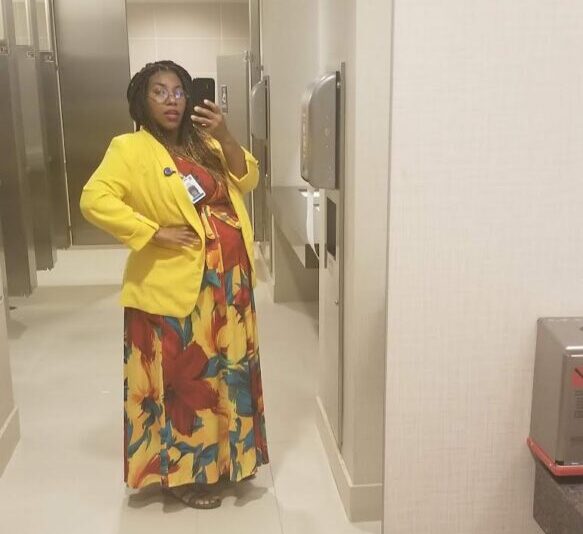
Tenaj Mays of McKinney was in the early stages of her first pregnancy when she first realized her corporate banking job might really be in jeopardy. She knew about the motherhood tax—the indirect punishment put on career women who attempt to straddle work and motherhood. She expected, at least, a temporary pause to her corporate ladder climbing, especially as a Black woman, too familiar with workplace inequities. Just like so many women before her, she wanted it all, but knew it probably wouldn’t happen at the same time.
As Mays, in her early thirties at the time, prepared to take her 12-week maternity leave, she was told by her manager, who was also a Black woman, that she was the first person who looked like them to take full maternity leave in her 20 years at the company. Mays was surprised and didn’t understand why mothers wouldn’t take all the possible time to heal and bond with their babies.
Mays’ mother had dealt with extreme postpartum after several of her pregnancies, so she tried to stay on top of everything she’d need, even planning for the unknown.
“ This is my first baby and I knew that I had already dealt with depression before. So I wasn’t afraid to express how I didn’t know how I was gonna manage postpartum depression.”
Other Black women in the company asked her how she managed to take that amount of leave. She said the questions came like whispers from women who wanted better accommodations, but didn’t know they were possible. Others scoffed at her boldness, while bragging about their overtime and hard work while pregnant. Mays even saw another Black woman start a role at her company two weeks postpartum, saying she put her newborn in daycare so that she wouldn’t miss out on the job opportunity.
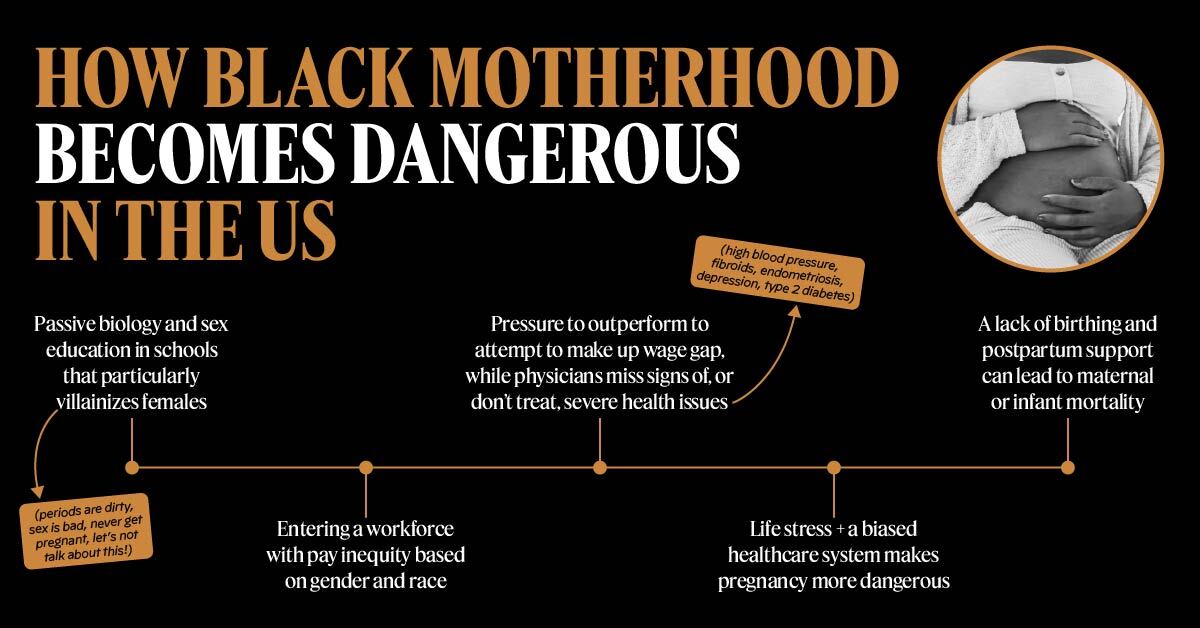
This is the reality for many Black women fighting against an array of biases that leave them making 63 cents to every dollar a white man earns. A continuous climb of their industry’s ladder is often the best bet to combat wealth gaps. The setback of motherhood is one many aren’t willing to take, and if they are, they’re working really hard to make sure there’s little sign of it from nine to five. Mays said it shouldn’t have to be that way.
“From what I’ve seen in the corporate arena, you have mothers who are ashamed of being a mother and the duties that come along with it.” Mays chalks that up to sexism, and not enough women in power openly representing a woman’s experience at work.
“ When a man is a father, the career skyrockets, like it’s something that’s so magical about everything that he does or how he talks about his child. But when I talk about my children … it was just not received the same way.”
The posturing and office power moves have long hinged on golf outings and football talk. In male-dominated fields, like banking, shared experiences over late-night feedings and toddler tantrums isn’t par for the course. Mays said this doesn’t just affect the more superficial parts of workplace culture, but can really affect health outcomes for employees who aren’t included.
Mothers need an advocate
Workplace discrimination and other stressors compound, and Black mothers end up at a higher risk for maternal and infant death before they ever enter labor and delivery. Black mothers have the highest mortality rates out of all groups— they are three times as likely to die in childbirth as their white counterparts. Black infant deaths lead the US infant mortality rates, too. A good chunk of those outcomes are determined by the medical care received.
Just like in all other parts of life, misognoir—the combination of anti-Black racism and sexism—is present in the health care system. Individuals hold biases before they become health care providers, and medical training doesn’t necessarily reduce that. Medical education often uses the needs of white, straight men to determine the standard of care, leaving many identities at risk in a doctor’s office or hospital bed. Black women, in particular, have turned to doulas to advocate for their needs before, during, and after childbirth.
As a young girl, Tequila Robertson was fascinated by pregnancy and birth. She’d watch TLC’s “A Baby Story” and did not look away when the mother pushed the baby out in a sheet of mysterious slime. Later in life, the Mansfield transplant watched the documentary “The Business of Being Born,” an examination of how the US approaches childbirth compared to other countries, and the discrepancies were alarming. She also heard the traumas and challenges from the pregnant women in her life—they felt like they needed an advocate in the delivery room, so they hired midwives to give holistic, personalized care. When Robertson was expecting her first child, she did the same and had a home birth with a midwife.
“ I actually want to feel my body. I wanna feel what it’s going through,” she said.
She and her husband really enjoyed the experience, and she started taking classes to become a doula. Doulas support you physically and emotionally throughout pregnancy and birth while educating you on all parts of the process. They aren’t medical professionals; rather, they serve as advocates for the mother’s best interests.
During her seven years of doula care, Robertson has spent most of her time preparing her clients for what to expect. She lays out their options in a variety of scenarios, so they can make the best decisions when it’s time to give birth. When it’s showtime, Robertson hosts the party, curating everything from the music to who’s in the room. When there’s a decision to be made, she explains the options to the mother and works to calm her enough to give a confident answer. Epidurals, inductions, c-sections—these all could have major consequences for both mother and child.
“ When [hospital staff] know we’re in the room, they know that these patients are educated and anything can’t fly,” she said.

Maternal health care in Texas is a conundrum. While the state has several of the country’s best hospitals, it ranks near the worst in level of care from its hospitals, with high costs, poor outcomes, and care that is more inaccessible than any other state. In a state that often promotes “pro-life” and “family values” policies, those gaps stand out: Texas ranks 50th out of 51 jurisdictions, including Washington, DC, in women’s health care quality. Black women bear the brunt of those failures, often paying with their lives.
“ I always say that it’s not gonna change until people’s pockets start hurting, so until doctors are held liable for the things that they are doing,” Robertson said.
She said more Black doctors won’t solve maternal health rates alone; there needs to be better training of nurses, implementation of evidence-based care, and broader access to care, particularly for those in rural areas. Since 2005, nearly 200 rural hospitals have either partially or completely shut down in the US.
Robertson is now working to make an even greater impact. She’s training to be a midwife, and hopes to offer the same peaceful and personalized care she received all those years ago.
“Your birth story will live with you forever,” she said. “You’re going to always remember how they came into this world … try to have the best story that you can.”
Mothers are not a liability
When Mays returned to work after having her second child, the atmosphere had shifted even more. Her new manager, a man, was making more frequent comments about the mothers on staff.
“‘The women are on vacation again,’” he’d joke.“It’s always a derogatory return when it comes down to talking to women about maternity leave,” said Mays. Her manager once asked her if she knew how not to have children.
He’d tell her that, in his eyes, the leave would have been grounds for termination. Mays was put on a coaching plan, what some call a performance improvement plan, after being on leave for months. Mays obtained an attorney and filed a complaint with the Equal Employment Opportunity Commission (EEOC) and her human resources department. Her manager resigned shortly after, and then her case played out for two years.
In the end, Mays received a settlement, but that meant she had to resign from the company. She hasn’t worked since.
Today, Mays, now 39, is proud of what she was able to accomplish for the women who came behind her. Her case helped bridge the gap between managers and returning parents, assessing their current needs while reintegrating them into the workplace. There’s now a toolkit that helps make these transitions easier. Mays is currently developing a workshop to help other companies create their own return-to-work support plans, so that career success can be more equitable.
“ That is the whole point. Motherhood is not a liability. It’s not a risk to the bottom line of the company,” she said. “We’re showing that you can work, raise your children, and be able to have a flourishing life as an employee without having to go through all these hoops.”