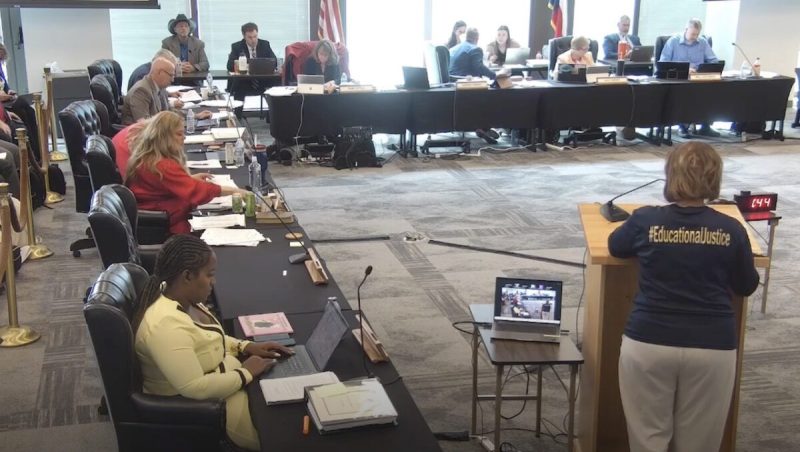
The Texas State Board of Education is meeting this week to decide the fate of new social studies teaching standards that critics say are being written by a hyper-partisan, far-right group of advisors.
Democratic members on the Texas State Board of Education are calling for an investigation into one of the content advisors in charge of the state’s current social studies overhaul after he didn’t disclose a “cash grant” provided by the Texas Public Policy Foundation, a far-right conservative think tank based in Austin.
According to a letter signed by all five Democrats on the board, public federal tax filings show that the TPPF awarded $70,000 to the Texas Center at Schreiner University, which is led by content advisor Donald Frazier, for the “Development of Texas Essential Knowledge & Skills (TEKS) Standards.”
“The failure to disclose this funding to the entire SBOE is deeply troubling, raises serious ethical concerns, and casts doubt over the integrity of the entire review process,” the board members said.
Frazier, a Texas historian, was appointed as one of nine advisers responsible for guiding the state as it rewrites how public schools will teach social studies for years to come.
Members Gustavo Reveles, Marisa Perez-Diaz, Staci Childs, Rebecca Bell-Metereau and Tiffany Clark are calling for a “comprehensive and independent investigation” into what conditions were tied to the grant between Frazier and the conservative think tank, and how the money may have influenced his decision making surrounding the TEKS rewrite.
“Given the scope and significance of this work, which impacts more than 5.5 million public school students across Texas, it is essential that the process remain transparent, objective, and free from undue influence,” the letter states.
The board members also called for an immediate pause on any further action surrounding the social studies TEKS review until their concerns are fully addressed.
“Board members have devoted significant time to hearing public testimony and reviewing extensive input from Texans across the state, many of whom have already expressed concern about the pace and transparency of this process,” the letter continues. “Proceeding without resolving these issues risks undermining public trust and calls into question the validity of any final decisions.”
The panel of content advisors has already faced scrutiny, with critics calling it “hyper-partisan” and sharing concerns that its members lack any relevant teaching experience.
Initial drafts of the social studies changes presented by the content advisors focuses more on Western civilization at the expense of other cultures, and prioritizes Christianity over other major world religions.
“I am pleased by the move toward a narrative approach to history, and an emphasis on Western Civilization as shaping the bedrock principles of our nation. I am glad to see an open discussion of Christianity as an influential force in shaping the American character,” Frazier wrote in his February recommendations draft. “Other world religions are treated with respect in most cases, yet the single most important shaper of American culture is sometimes treated with trepidation.”
If no action is taken toward Frazier, the board is expected to move ahead with a preliminary vote over the new social studies framework by the end of the week. A final vote is set to take place in June.